
Insights · Article
AI can only use the data it can find
Every organization has more data than it can use. Before investing in AI, the question that matters is whether it is ready to use its own data.
Where the data lives
A hospital, a research lab, a school, a company: the information exists, but it lives in PDFs, spreadsheets, e-mails and systems that do not talk to each other.
Without access to reliable information, AI may produce answers that are incomplete, incorrect or unfounded. The model is rarely the bottleneck; the data it can reach usually is.
What the surveys say
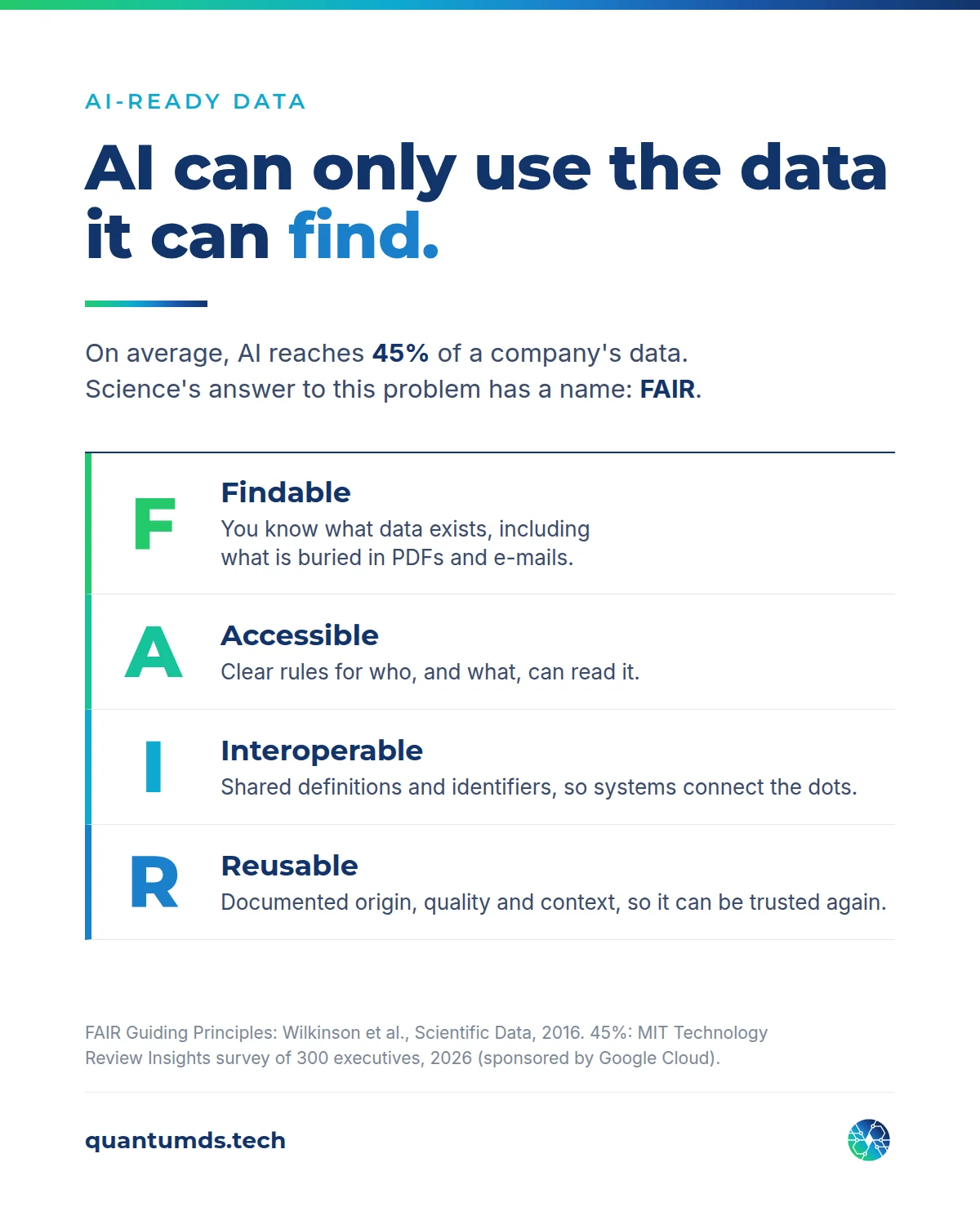
In a 2026 survey by MIT Technology Review Insights, sponsored by Google Cloud, executives estimated that AI can access, on average, only 45% of their organization's data.
Independent research by RAND, based on interviews with 65 experienced data scientists and engineers, lists the lack of the necessary data, and of the infrastructure to manage it, among the five leading root causes of AI project failure.
These are two different kinds of evidence: a self-reported estimate from executives and a qualitative study of practitioners. Both point in the same direction: limited access to data is associated with AI initiatives that fall short.
More access is not less protection
More access to data does not mean releasing everything to AI. In health and finance, much of it must stay protected.
Well-organized data makes it easier to apply privacy and security controls: identifying and protecting personal information, controlling access by permission, and tracking who accessed what. Structure and protection tend to go together, not against each other.
FAIR: science's answer, a decade on
Science hit this wall a decade ago and answered with four principles, published in 2016: FAIR data are Findable, Accessible, Interoperable and Reusable.
- Findable. You know what data exists, including what is buried in PDFs and e-mails, and each dataset has an identifier and enough metadata to be located.
- Accessible. Clear rules for who, and what, can read it, through standard, documented means.
- Interoperable. Shared definitions and identifiers, so that systems can connect the dots.
- Reusable. Documented origin, quality and context, so the data can be trusted again, by people or by models.
Ten years later, written for researchers sharing data with other researchers, the principles read like a checklist for AI.
A question before investing
Before investing in AI, is your organization ready to use its own data? And which of the four principles is the biggest challenge today? For most organizations the answer is not the same for all four, and that is where the work begins.
Sources
- MIT Technology Review Insights, "Scaling AI agents with trustworthy data" (2026). Report sponsored by Google Cloud.
- RAND Corporation, "The Root Causes of Failure for Artificial Intelligence Projects and How They Can Succeed" (2024).
- Wilkinson, M. D. et al., "The FAIR Guiding Principles for scientific data management and stewardship", Scientific Data 3, 160018 (2016).